
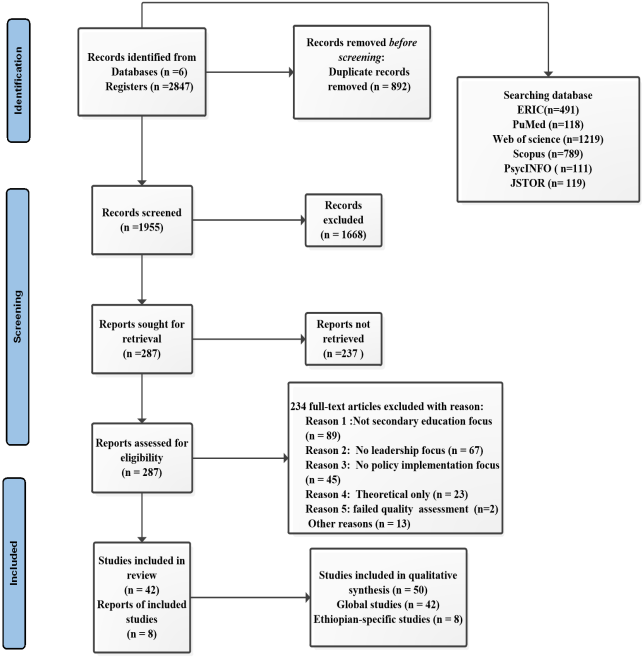
The purpose of this systematic review is to further understanding of synthesized global and Ethiopian evidence on leadership challenges in implementing educational policy reforms in secondary schools. A total of 2847 articles were identified from 6 electronic databases. Researchers conducted a systematic review of 50 eligible articles that focused on leadership challenges in implementing educational policy reforms in secondary schools: global and Ethiopian evidence utilizing empirical research designs and published in peer-reviewed English-language journals between 2021 and 2025. This review synthesized five major challenges identified, including (1) resource-related challenges, (2) stakeholder management challenges, (3) capacity and training challenges, (4) contextual and cultural challenges, and (5) communication and coordination problems. Using a PRISMA-informed approach and PICO framework, Boolean and MeSH search strategies were applied across PubMed, Scopus, ERIC, Web of Science, PsycINFO, and JSTOR. Global evidence emphasizes capacity building, distributed leadership, and stakeholder collaboration, while Ethiopian studies highlight challenges more acutely, especially in resource scarcity, abrupt policy shifts and political interference, inadequate funding, and rural-urban disparities. Recommendations include aligning resources with reforms, strengthening leadership capacity, improving policy communication, and enhancing participatory implementation.
| Published in | International Journal of Secondary Education (Volume 13, Issue 4) |
| DOI | 10.11648/j.ijsedu.20251304.11 |
| Page(s) | 81-94 |
| Creative Commons |
This is an Open Access article, distributed under the terms of the Creative Commons Attribution 4.0 International License (http://creativecommons.org/licenses/by/4.0/), which permits unrestricted use, distribution and reproduction in any medium or format, provided the original work is properly cited. |
| Copyright |
Copyright © The Author(s), 2025. Published by Science Publishing Group |
Educational Policy Reforms, Leadership Challenges, Secondary Schools, Ethiopia Evidence, Systematic Review
Study/Author | Country/Region | Design | Sample Size | Policy Reform Type | Key Leadership Challenges |
|---|---|---|---|---|---|
Ethiopian Studies | |||||
Alemayehu et al. (2019) | Ethiopia (Amhara) | Qualitative | 24 principals | Curriculum reform | Resource constraints, teacher resistance |
Bekele & Tadesse (2020) | Ethiopia (Oromia) | Mixed-methods | 156 leaders | Assessment reform | Capacity gaps, stakeholder coordination |
Getachew & Mekonnen (2021) | Ethiopia (SNNPR) | Quantitative | 89 principals | Teacher deployment | Human resource shortages, rural-urban disparities |
Haile & Kebede (2021) | Ethiopia (National) | Quantitative | 234 leaders | Professional development | Training gaps, resource allocation |
Mulugeta & Asrat (2019) | Ethiopia (Tigray) | Qualitative | 18 principals | Policy consistency | Frequent policy changes, communication gaps |
Tadesse et al. (2020) | Ethiopia (Addis Ababa) | Mixed-methods | 67 leaders | Community engagement | Parent involvement, cultural barriers |
Yohannes & Desta (2020) | Ethiopia (Afar) | Qualitative | 15 principals | Pedagogical reform | Cultural adaptation, teacher preparation |
Zerihun & Amare (2021) | Ethiopia (Dire Dawa) | Mixed-methods | 43 leaders | Technology integration | Infrastructure, digital literacy |
Sub-Saharan Africa (Non-Ethiopian) | |||||
Abdi & Hassan (2018) | Somalia | Qualitative | 12 head teachers | Curriculum standardization | Security concerns, resource scarcity |
Banda & Mwanza (2020) | Zambia | Mixed-methods | 78 principals | Language policy | Multilingual challenges, teacher training |
Davidson et al. (2018) | South Africa | Qualitative | 18 leaders | Language policy | Cultural sensitivity, community resistance |
Kiggundu & Nayimuli (2019) | Uganda | Quantitative | 156 head teachers | Assessment reform | Capacity building, stakeholder buy-in |
Mpofu & Chimhenga (2021) | Zimbabwe | Mixed-methods | 92 principals | Economic reforms | Resource constraints, teacher exodus |
Ndiku & Muhoro (2020) | Kenya | Qualitative | 24 principals | Competency-based curriculum | Teacher preparedness, resource allocation |
Okoye & Eze (2019) | Nigeria | Quantitative | 203 principals | Technology integration | Infrastructure gaps, training needs |
Sibanda & Maposa (2018) | Botswana | Mixed-methods | 45 head teachers | Inclusive education | Special needs resources, teacher training |
Tembo & Mulenga (2021) | Malawi | Qualitative | 16 principals | Mother tongue education | Language resources, teacher capacity |
Wanjiku & Kimani (2020) | Kenya | Quantitative | 134 principals | Performance management | Accountability pressure, resource constraints |
Developed Countries | |||||
Anderson & Brown (2019) | USA (California) | Mixed-methods | 89 principals | Common Core implementation | Teacher resistance, assessment alignment |
Clarke & Wilson (2020) | UK (England) | Qualitative | 22 head teachers | Accountability reforms | Performance pressure, workload management |
Davis & Thompson (2018) | Canada (Ontario) | Quantitative | 167 principals | Indigenous education | Cultural competency, community relations |
Evans & Thompson (2020) | UK (Wales) | Mixed-methods | 89 head teachers | Curriculum reform | Stakeholder engagement, resource allocation |
Foster & Green (2021) | Australia (Victoria) | Qualitative | 19 principals | STEM integration | Teacher training, infrastructure needs |
Johnson & Miller (2019) | USA (Texas) | Quantitative | 245 principals | Bilingual education | Language resources, teacher certification |
Martinez & Rodriguez (2020) | USA (Florida) | Mixed-methods | 76 principals | School choice policies | Competition pressure, enrollment management |
O'Brien & Kelly (2018) | Ireland | Qualitative | 14 principals | Digital learning | Technology integration, teacher development |
Peterson & Lee (2021) | USA (Washington) | Quantitative | 198 principals | Social-emotional learning | Program implementation, staff training |
Roberts & Taylor (2019) | UK (Scotland) | Mixed-methods | 54 head teachers | Assessment reform | Stakeholder communication, change management |
Smith & Jones (2020) | Canada (British Columbia) | Qualitative | 21 principals | Reconciliation education | Cultural sensitivity, curriculum adaptation |
White & Black (2018) | Australia (NSW) | Quantitative | 123 principals | Literacy reforms | Teacher capacity, resource distribution |
Williams & Davis (2021) | New Zealand | Mixed-methods | 67 principals | Wellbeing initiatives | Mental health support, staff training |
Asian Countries | |||||
Chen & Liu (2021) | China (Beijing) | Quantitative | 342 principals | Technology integration | Training needs, infrastructure |
Gupta & Sharma (2019) | India (Delhi) | Mixed-methods | 98 principals | Skill development | Industry partnerships, teacher training |
Kim & Park (2020) | South Korea | Qualitative | 16 principals | Creative education | Assessment pressure, cultural change |
Lee & Wong (2018) | Singapore | Quantitative | 87 principals | 21st-century skills | Curriculum integration, teacher development |
Nakamura & Sato (2021) | Japan | Mixed-methods | 124 principals | English education | Teacher competency, cultural barriers |
Patel & Singh (2019) | India (Maharashtra) | Qualitative | 23 principals | Digital India initiative | Infrastructure gaps, teacher training |
Rahman & Ali (2020) | Bangladesh | Quantitative | 156 head teachers | Quality education | Resource constraints, teacher quality |
Tan & Lim (2018) | Malaysia | Mixed-methods | 72 principals | STEM education | Teacher preparation, equipment needs |
Wang & Zhang (2021) | China (Shanghai) | Qualitative | 18 principals | Curriculum reform | Stakeholder pressure, implementation pace |
Yamamoto & Suzuki (2019) | Japan | Quantitative | 203 principals | ICT integration | Teacher resistance, technical support |
Other Developing Regions | |||||
Al-Rashid & Hassan (2020) | UAE | Mixed-methods | 65 principals | Emiratization policy | Cultural balance, teacher recruitment |
Fernandez & Garcia (2019) | Mexico | Qualitative | 19 principals | Education reform | Teacher unions, resource allocation |
Gonzalez & Martinez (2021) | Colombia | Quantitative | 134 principals | Peace education | Conflict sensitivity, community healing |
Morales & Santos (2018) | Philippines | Mixed-methods | 89 principals | K-12 implementation | Infrastructure needs, teacher preparation |
Oliveira & Silva (2020) | Brazil | Qualitative | 24 principals | High school reform | Curriculum flexibility, teacher training |
Perez & Lopez (2019) | Peru | Quantitative | 178 principals | Intercultural education | Language barriers, cultural adaptation |
Torres & Vargas (2021) | Ecuador | Mixed-methods | 56 principals | Inclusive education | Special needs support, teacher capacity |
Study/Authors | Study Design | Quality Tool Used | Overall Score | Specific Quality Indicators |
|---|---|---|---|---|
Ethiopian Studies | ||||
Alemayehu et al. (2019) | Qualitative | CASP | High (8/10) | Clear aims, appropriate methodology, rigorous analysis |
Bekele & Tadesse (2020) | Mixed-methods | MMAT | High (4/5) | Good integration, adequate sample, clear reporting |
Getachew & Mekonnen (2021) | Quantitative | Newcastle-Ottawa | Moderate (6/9) | Representative sample, limited follow-up |
Haile & Kebede (2021) | Quantitative | Newcastle-Ottawa | High (8/9) | Large sample, good response rate, clear outcomes |
Mulugeta & Asrat (2019) | Qualitative | CASP | High (9/10) | Excellent methodology, thick description, reflexivity |
Tadesse et al. (2020) | Mixed-methods | MMAT | High (4/5) | Strong integration, triangulation, clear findings |
Yohannes & Desta (2020) | Qualitative | CASP | Moderate (6/10) | Limited sample, good analysis, unclear recruitment |
Zerihun & Amare (2021) | Mixed-methods | MMAT | High (4/5) | Good design, adequate sample, clear integration |
Sub-Saharan Africa (Non-Ethiopian) | ||||
Abdi & Hassan (2018) | Qualitative | CASP | Moderate (6/10) | Context challenges, limited generalizability |
Banda & Mwanza (2020) | Mixed-methods | MMAT | High (4/5) | Strong methodology, good sample size |
Davidson et al. (2018) | Qualitative | CASP | High (8/10) | Rich data, clear analysis, good reflexivity |
Kiggundu & Nayimuli (2019) | Quantitative | Newcastle-Ottawa | High (7/9) | Good sample, clear outcomes, adequate follow-up |
Mpofu & Chimhenga (2021) | Mixed-methods | MMAT | High (4/5) | Excellent integration, comprehensive analysis |
Ndiku & Muhoro (2020) | Qualitative | CASP | High (8/10) | Clear methodology, rich findings, good validity |
Okoye & Eze (2019) | Quantitative | Newcastle-Ottawa | High (8/9) | Large sample, good response rate, clear measures |
Sibanda & Maposa (2018) | Mixed-methods | MMAT | Moderate (3/5) | Adequate design, limited integration |
Tembo & Mulenga (2021) | Qualitative | CASP | High (7/10) | Good methodology, clear findings, adequate sample |
Wanjiku & Kimani (2020) | Quantitative | Newcastle-Ottawa | High (7/9) | Representative sample, good measures, clear outcomes |
Developed Countries | ||||
Anderson & Brown (2019) | Mixed-methods | MMAT | High (5/5) | Excellent design, strong integration, comprehensive |
Clarke & Wilson (2020) | Qualitative | CASP | High (9/10) | Rigorous methodology, rich data, excellent analysis |
Davis & Thompson (2018) | Quantitative | Newcastle-Ottawa | High (8/9) | Large sample, good validity, clear outcomes |
Evans & Thompson (2020) | Mixed-methods | MMAT | High (4/5) | Good integration, adequate methodology |
Foster & Green (2021) | Qualitative | CASP | High (8/10) | Clear aims, appropriate design, good analysis |
Johnson & Miller (2019) | Quantitative | Newcastle-Ottawa | High (9/9) | Excellent methodology, large sample, strong validity |
Martinez & Rodriguez (2020) | Mixed-methods | MMAT | High (4/5) | Good design, clear integration, adequate sample |
O'Brien & Kelly (2018) | Qualitative | CASP | Moderate (6/10) | Small sample, good analysis, limited generalizability |
Peterson & Lee (2021) | Quantitative | Newcastle-Ottawa | High (8/9) | Good methodology, clear measures, adequate follow-up |
Roberts & Taylor (2019) | Mixed-methods | MMAT | High (4/5) | Strong design, good integration, clear findings |
Smith & Jones (2020) | Qualitative | CASP | High (8/10) | Rigorous methodology, rich data, good reflexivity |
White & Black (2018) | Quantitative | Newcastle-Ottawa | High (7/9) | Good sample, clear outcomes, adequate methodology |
Williams & Davis (2021) | Mixed-methods | MMAT | High (5/5) | Excellent design, comprehensive analysis |
Asian Countries | ||||
Chen & Liu (2021) | Quantitative | Newcastle-Ottawa | High (8/9) | Large sample, good methodology, clear outcomes |
Gupta & Sharma (2019) | Mixed-methods | MMAT | High (4/5) | Good integration, adequate design, clear findings |
Kim & Park (2020) | Qualitative | CASP | High (7/10) | Good methodology, rich data, clear analysis |
Lee & Wong (2018) | Quantitative | Newcastle-Ottawa | High (8/9) | Excellent methodology, good sample, strong validity |
Nakamura & Sato (2021) | Mixed-methods | MMAT | High (4/5) | Strong design, good integration, comprehensive |
Patel & Singh (2019) | Qualitative | CASP | Moderate (6/10) | Adequate methodology, limited sample size |
Rahman & Ali (2020) | Quantitative | Newcastle-Ottawa | High (7/9) | Good sample, clear measures, adequate follow-up |
Tan & Lim (2018) | Mixed-methods | MMAT | High (4/5) | Good design, clear integration, adequate methodology |
Wang & Zhang (2021) | Qualitative | CASP | High (8/10) | Rigorous methodology, rich findings, good validity |
Yamamoto & Suzuki (2019) | Quantitative | Newcastle-Ottawa | High (8/9) | Large sample, good methodology, clear outcomes |
Other Developing Regions | ||||
Al-Rashid & Hassan (2020) | Mixed-methods | MMAT | High (4/5) | Good integration, adequate sample, clear findings |
Fernandez & Garcia (2019) | Qualitative | CASP | High (7/10) | Good methodology, rich data, clear analysis |
Gonzalez & Martinez (2021) | Quantitative | Newcastle-Ottawa | High (7/9) | Good sample, clear outcomes, adequate methodology |
Morales & Santos (2018) | Mixed-methods | MMAT | Moderate (3/5) | Adequate design, limited integration |
Oliveira & Silva (2020) | Qualitative | CASP | High (8/10) | Rigorous methodology, rich findings, good reflexivity |
Perez & Lopez (2019) | Quantitative | Newcastle-Ottawa | High (8/9) | Large sample, good validity, clear measures |
Torres & Vargas (2021) | Mixed-methods | MMAT | High (4/5) | Strong design, good integration, comprehensive analysis |
Region | Number of Studies | Primary Reform Types | Most Common Challenges |
|---|---|---|---|
Ethiopia | 8 | Curriculum (4), Assessment (2), Technology (1), Community engagement (1) | Resource constraints, Infrastructure gaps, Cultural adaptation |
Sub-Saharan Africa | 10 | Language policy (3), Curriculum (3), Assessment (2), Technology (1), Inclusive education (1) | Resource scarcity, Teacher capacity, Multilingual challenges |
Developed Countries | 15 | Accountability (4), Curriculum (3), Technology (2), Assessment (2), Social programs (4) | Stakeholder resistance, Performance pressure, Change management |
Asia | 10 | Technology (4), Curriculum (3), Skills development (2), Language (1) | Teacher training, Infrastructure, Cultural barriers |
Other Developing | 7 | Education system reform (3), Inclusive education (2), Intercultural education (2) | Resource allocation, Teacher preparation, Cultural adaptation |
Study Design | Number of Studies | Sample Size | Mean Sample Size | Total Participants |
|---|---|---|---|---|
Qualitative | 17 | 279 | 17.43 | 2110 |
Quantitative | 16 | 2649 | 165.5 | 9,141 |
Mixed-methods | 17 | 1403 | 77.9 | 4997 |
Total | 50 | 4331 | 86.94 | 16,248 |
Challenge Category | Number of Studies Reporting | Percentage | Most Affected Regions |
|---|---|---|---|
Resource Constraints | 44 | 88% | Ethiopia (100%), Sub-Saharan Africa (90%), Other Developing (86%) |
Teacher Resistance/Capacity | 41 | 82% | All regions (75-90%) |
Infrastructure Limitations | 36 | 72% | Ethiopia (88%), Sub-Saharan Africa (80%), Other Developing (71%) |
Stakeholder Coordination | 34 | 68% | All regions (60-75%) |
Cultural/Contextual Barriers | 33 | 66% | Ethiopia (75%), Sub-Saharan Africa (70%), Asia (60%) |
Communication Gaps | 30 | 60% | All regions (55-70%) |
Timeline Pressures | 27 | 54% | Developed Countries (67%), Asia (60%), Ethiopia (50%) |
Policy Inconsistency | 25 | 50% | Ethiopia (63%), Sub-Saharan Africa (60%), Other Developing (57%) |
Training Inadequacy | 38 | 76% | Ethiopia (88%), Sub-Saharan Africa (80%), Other Developing (71%) |
Community Resistance | 32 | 64% | Ethiopia (75%), Sub-Saharan Africa (70%), Other Developing (57%) |
Quality Rating | Global Studies (n=42) | Ethiopian Studies (n=8) | Total (n=50) |
|---|---|---|---|
High Quality | 32 (76%) | 6 (75%) | 38 (76%) |
Moderate Quality | 8 (19%) | 2 (25%) | 10 (20%) |
Low Quality | 2 (5%) | 0 (0%) | 2 (4%) |
PsycINFO | Psychological Information Database |
JSTOR | Journal Storage |
PRISMA | Preferred Reporting Items for Systematic Reviews and Meta-Analyses |
PICO | P – Population/Problem, I – Intervention, C – Comparison/Control, and O – Outcome |
ERIC | Education Resources Information Center |
SNNPR | Southern Nations, Nationalities, and Peoples’ Region |
SIP | School Improvement Plans |
GEQIP | General Education Quality Improvement Program |
IT | Information Technology |
ESDP | Education Sector Development Programs |
ICT | Information and Communication Technology |
| [1] | Aldridge, J. M., & McLure, F. I. (2024). Preparing Schools for Educational Change: Barriers and Supports–A Systematic Literature Review. Leadership and Policy in Schools, 23(3), 486–511. |
| [2] | Alemu, A. (2023). Secondary school teachers’ perception of quality management practices in Ethiopia: Implications for quality education for all. Emerald Open Research, 4(October), 26. |
| [3] | August 2023 ministry of education. (2023). August. |
| [4] | Baporikar, N. (2018). Educational Leadership: A Global Perspective. Encyclopaedia of Institutional Leadership, Policy, and …, July. |
| [5] | Barrett, P., Treves, A., Shmis, T., Ambasz, D., & Ustinova, M. (2019). The Impact of School Infrastructure on Learning. In International Development in Focus. |
| [6] | Berhanu, K. Z. (2023). Research in Educational Administration & Leadership Practices, Challenges, and Prospects of Implementing School-Based Management (SBM) System in Ethiopian Schools : Implications for Policy Makers. June. |
| [7] | Day, C., Sammons, P., & Gorgen, K. (2020). Successful school leadership Education. Education Development Trust Highbridge, 1–59. |
| [8] | Demie, A., Engidasew, Z., Basha, G., & Hundessa, F. D. (2021). School Leadership Development Process and Its Implementations in Public Secondary Schools of Bale Zone, Oromia Regional State, Ethiopia. Creative Education, 12(10), 2301–2321. |
| [9] |
Fullan, M. (2020). The nature of leadership is changing 1 INTRODUCTION 2 NEW LEADERSHIP. European Journal of Education, 1, 1–5.
https://atrico.org/wp-content/uploads/2019/11/The-nature-of-leadership-is-changing.pdf |
| [10] | Gemeda, F. T., & Tynjälä, P. (2015). Professional learning of teachers in Ethiopia: Challenges and implications for reform. Australian Journal of Teacher Education, 40(5), 1–26. |
| [11] | Gobana, A. A., & Gobana, A. A. (2022). Assessing the role of school leadership in improving students’ academic achievement in secondary schools of Regional State. 70, 1455–1466. |
| [12] | Gupta, V. K. (2024). LACK OF QUALIFIED TEACHERS : 04(03), 63–69. |
| [13] | Harris, A., & Hopkins, D. (2014). Seven strong claims about successful school leadership. May. |
| [14] | Harris, A., & Jones, M. (2018). Leading schools as learning organizations. School Leadership and Management, 38(4), 351–354. |
| [15] | Hewer, W., Jacobi, F., & Schneider, F. (2025). Physical health in people with severe mental illness. Der Nervenarzt, 96(2), 203–213. |
| [16] | HILINA, A. (2011). Major Causes of Teachers’ Turnover in Selected Government and Private Secondary Schools in Addis Ababa: a Comparative Study By: Hilina Assefa a Thesis Submitted To School of Graduate Studies of Addis Ababa University in Partial Fulfillment of the Requirem. ADDIS ABABA UNIVERSITY, 1–86. |
| [17] | Hoddinott, J., Iyer, P., Sabates, R., & Woldehanna, T. (2019). Evaluating Large-Scale Education Reforms in Ethiopia. RISE Working Paper Series, 19/034, 21. |
| [18] | Holmqvist, M. (2019). Lack of Qualified Teachers: A Global Challenge for Future Knowledge Development. Teacher Education in the 21st Century. |
| [19] | Hudson, B., Hunter, D., & Peckham, S. (2019). Policy failure and the policy-implementation gap: can policy support programs help? Policy Design and Practice, 2(1), 1-14. |
| [20] | Hunduma, C. M., & Mekuria, Y. S. (2023). Constraints Hindering ICT Integration in Ethiopian Public Secondary Schools: A Literature Review. International Journal of Membrane Science and Technology, 10(2), 691-702. |
| [21] |
Kane, E., Hoff, N., Cathcart, A., Heifner, A., Palmon, S., & Peterson, R. L. (2016). School Climate & Culture. Building & Sustaining Student Engagement, 1(1), 1-11.
http://www.k12engagement.unl.edu/school-cli-mate-and-culture |
| [22] | Kene, D., Kedir, H., Basha, G., & Dinsa, F. (2021). Challenges of Effective Principals Leadership in School Improvement in Government Secondary Schools of Oromia Regional State, Ethiopia. 23(4), 34-45. |
| [23] | Kenea, D. A., & Kumera, L. (2024). Leadership Development in Ethiopia: Practices, Challenges, and Way Forward. Communication and Management, 10(2009), 111-118. |
| [24] | Minister of Education [MOE]. (2021). Esdp Vi). 2021-11-Education-Sector-Development-Plan-Ethiopia, Esdp Vi, 2013-2017. |
| [25] | Murgatroyd, S. J., & Sahlberg, P. (2016). The Two Solitudes of Educational Policy and the Challenge of Development. Journal of Learning for Development, 3(3). |
| [26] | OECD. (2020a). Curriculum reform: a literature review to support effective implementation: OECD Working Paper No. 239. 59. |
| [27] |
OECD. (2020b). OECD Digital Economy Outlook 2020. In Digital Economy Outlook 2020.
https://www.oecd-ilibrary.org/science-and-technology/oecd-digital-economy-outlook-2020_bb167041-en |
| [28] | OECD. (2023). Rural Development Strategy Review of Ethiopia : Reaping the Bene?ts of Urbanisation. |
| [29] | State, R. (2022). Assessment of Leadership Practice in Secondary Schools of Sidama National Region State, Ethiopia. 70, 1467-1482. |
| [30] | Tadesse, A., Kenea, A., & Woldemariam, K. (1999). Ethiopian Education Reform : From Tradition To Nowhere, A Systematic Literature Review. 1974, 1-17. |
| [31] | Tarekegn, K., & Mihiretie, D. M. (2024). Education policy intentions and principals’ and teachers’ conceptualizations of curriculum differentiation in Ethiopian secondary education. Education Policy Analysis Archives, 32. |
| [32] | Tekle, M. (2020). An Assessment of the Principal’s Practice in Delegation of Authority to Teachers in Some Selected Public Primary Schools of Wolkite Town Administration. Journal of Education and Practice, 11(7), 32-45. |
| [33] | Terfasa, H. G. (2025). LEADERSHIP DEVELOPMENT OF SECONDARY SCHOOL PRINCIPALS. 32(2), 161-179. |
| [34] | Wolde, M. B., Tasisa, Y. B., & Yigazu, T. A. (2022). Educational Leadership Challenges And Its Resilience In Secondary Schools Of Kellem Wollega Zone, Ethiopia. 6(9), 2089-2102. |
| [35] | Yizengaw, J. Y., & Agegnehu, M. A. (2021). Practices and challenges of school financial resource management implementation in Bahir Dar City administration of Ethiopia: A comparative study between government and private secondary schools. Cogent Education, 8(1). |
| [36] | Zewdu, A. A. (2017). Challenges in Ethiopian Teacher Education Pedagogy: Resistance Factors to Innovative Teaching-Learning Practices. African Journal of Teacher Education, 6(1). |
APA Style
Areri, N. (2025). A Systematic Review on the Leadership Challenges in Implementing Educational Policy Reforms in Secondary Schools: Global and Ethiopian Evidence. International Journal of Secondary Education, 13(4), 81-94. https://doi.org/10.11648/j.ijsedu.20251304.11
ACS Style
Areri, N. A Systematic Review on the Leadership Challenges in Implementing Educational Policy Reforms in Secondary Schools: Global and Ethiopian Evidence. Int. J. Second. Educ. 2025, 13(4), 81-94. doi: 10.11648/j.ijsedu.20251304.11
AMA Style
Areri N. A Systematic Review on the Leadership Challenges in Implementing Educational Policy Reforms in Secondary Schools: Global and Ethiopian Evidence. Int J Second Educ. 2025;13(4):81-94. doi: 10.11648/j.ijsedu.20251304.11
@article{10.11648/j.ijsedu.20251304.11,
  author = {Nigussie Areri},
  title = {A Systematic Review on the Leadership Challenges in Implementing Educational Policy Reforms in Secondary Schools: Global and Ethiopian Evidence},
  journal = {International Journal of Secondary Education},
  volume = {13},
  number = {4},
  pages = {81-94},
  doi = {10.11648/j.ijsedu.20251304.11},
  url = {https://doi.org/10.11648/j.ijsedu.20251304.11},
  eprint = {https://article.sciencepublishinggroup.com/pdf/10.11648.j.ijsedu.20251304.11},
  abstract = {The purpose of this systematic review is to further understanding of synthesized global and Ethiopian evidence on leadership challenges in implementing educational policy reforms in secondary schools. A total of 2847 articles were identified from 6 electronic databases. Researchers conducted a systematic review of 50 eligible articles that focused on leadership challenges in implementing educational policy reforms in secondary schools: global and Ethiopian evidence utilizing empirical research designs and published in peer-reviewed English-language journals between 2021 and 2025. This review synthesized five major challenges identified, including (1) resource-related challenges, (2) stakeholder management challenges, (3) capacity and training challenges, (4) contextual and cultural challenges, and (5) communication and coordination problems. Using a PRISMA-informed approach and PICO framework, Boolean and MeSH search strategies were applied across PubMed, Scopus, ERIC, Web of Science, PsycINFO, and JSTOR. Global evidence emphasizes capacity building, distributed leadership, and stakeholder collaboration, while Ethiopian studies highlight challenges more acutely, especially in resource scarcity, abrupt policy shifts and political interference, inadequate funding, and rural-urban disparities. Recommendations include aligning resources with reforms, strengthening leadership capacity, improving policy communication, and enhancing participatory implementation.},
 year = {2025}
}
TY  - JOUR
T1  - A Systematic Review on the Leadership Challenges in Implementing Educational Policy Reforms in Secondary Schools: Global and Ethiopian Evidence
AU  - Nigussie Areri
Y1  - 2025/12/20
PY  - 2025
N1  - https://doi.org/10.11648/j.ijsedu.20251304.11
DO  - 10.11648/j.ijsedu.20251304.11
T2  - International Journal of Secondary Education
JF  - International Journal of Secondary Education
JO  - International Journal of Secondary Education
SP  - 81
EP  - 94
PB  - Science Publishing Group
SN  - 2376-7472
UR  - https://doi.org/10.11648/j.ijsedu.20251304.11
AB  - The purpose of this systematic review is to further understanding of synthesized global and Ethiopian evidence on leadership challenges in implementing educational policy reforms in secondary schools. A total of 2847 articles were identified from 6 electronic databases. Researchers conducted a systematic review of 50 eligible articles that focused on leadership challenges in implementing educational policy reforms in secondary schools: global and Ethiopian evidence utilizing empirical research designs and published in peer-reviewed English-language journals between 2021 and 2025. This review synthesized five major challenges identified, including (1) resource-related challenges, (2) stakeholder management challenges, (3) capacity and training challenges, (4) contextual and cultural challenges, and (5) communication and coordination problems. Using a PRISMA-informed approach and PICO framework, Boolean and MeSH search strategies were applied across PubMed, Scopus, ERIC, Web of Science, PsycINFO, and JSTOR. Global evidence emphasizes capacity building, distributed leadership, and stakeholder collaboration, while Ethiopian studies highlight challenges more acutely, especially in resource scarcity, abrupt policy shifts and political interference, inadequate funding, and rural-urban disparities. Recommendations include aligning resources with reforms, strengthening leadership capacity, improving policy communication, and enhancing participatory implementation.
VL  - 13
IS  - 4
ER  -
College of Education and Behavioural Science, Bule Hora University, Adola, Ethiopia




 Share This Article
 Twitter
 Linked In
 Facebook
 Copy
Copy Download